|
Staplford
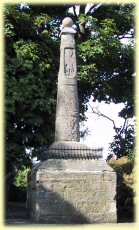
Cross. circa 1906 |
This splendid shaft, the oldest ecclesiastical
monument of Nottinghamshire now standing, is said to have
been placed in its present position at a cross
road in 1760. Previous to that
it was lying in the churchyard, perhaps nearer to its
original site. The square base on which it now stands
was re-constructed in 1820, when the square cap, surmounted
by a ball, was added to the shaft.
It appears as a cylindrical shaft,
about 10 ft. high, but is CROSS more accurately described
as square, with rounded faces tapering to a square at
the top, from which the cross head probably sprang. The
diameter of the shaft at the base is about 2ft. it has
three bands of surface sculpture, divided by horizontal
lines. The two lower portions are covered with interlaced
ornament of continuous scrolls, more or less showing a
change of pattern on each of the flattened sides. The
central band especially is of wonderful intricacy of lines
alternately forming the diameter and circumference of
the pattern with which the surface is covered.
The upper part, where the shaft
becomes square, is much worn, except on one face, which
has upon it a symbolical birdlike figure with wings
trampling upon a serpent. Close observation reveals the
head to be that of an ox with horns, probably the emblem
of St. Luke. The other faces may have borne the emblems
of the other Evangelists. Dr. G. P. Browne, now Bishop
of Bristol, was the first to point out the meaning of
the figure, and he suggests, as an interesting corroboration,
that Stapleford feast is governed by St. Luke’s
day, or rather “old St. Luke’s,” which
corresponds to our October 30th. “Feast Sunday is
the last Sunday in October, unless that be the last day,
and then it is the last but one;” this is the rule
still recognised by Stapleford inhabitants. Of course
the feast Sunday could not be on October 31st, for then
the week could not include old St. Luke’s day. (The
Conversion of the Heptarchy. Browne. S.P.C.K.). The church
is dedicated to St. Helen, but we have, no doubt, in this
cross, the record of a still older dedication of the locality
by the earliest Christian teachers in these parts.
 |
| Stapleford
Cross in 2002. It has been moved into the churchyard
for its own protection (© A Nicholson, 2002). |
Two questions of interest arise
in connection with this monument. Whence came the art
with which these wonderfully intricate scroll-work patterns
are produced? What is the probable date of the Stapleford
cross?
The earliest Anglian example of
the scroll-work is without doubt to be found on the great
cross at Bewcastle, which from its inscriptions can
be dated 670. This is earlier than any of the Irish work,
which is usually described as the original source of the
art. Following Bishop Browne, I think we must look to
the influence of Byzantine art, through Lombardy, where
similar work is found, brought perhaps to this country
by Wilfrith and Biscop, as giving the impulse which produced
the Lindisfarne school of ornament, the interlacement
of continuous flowing bands, so especially developed as
an Anglian characteristic, both in manuscript and masonry.
The latter half of the 7th century
saw the conversion of the kingdom of Mercia to Christianity,
after the death of the stout old heathen, Penda, through
the influence of the Northumbrian, Oswy, and his son,
Alchfrith, who is commemorated on the Bewcastle cross,
and of the saintly Chad, Bishop of Lichfield, The 8th
century saw its rise to supremacy among the kingdoms of
the Heptarchy.
Nottinghamshire, as a borderland
between two great kingdoms, must have often felt the tide
of conquest swaying this way and that, and the erection
of a great cross close to the stream, which marks the
county boundary, may have had a civil as well as an ecclesiastical
significance. The village, as Mr. W. Stevenson has suggested,
derives its name of Staple-ford from the tall shaft (A.S.
Stepel, whence our word steeple, or stapol, a prop or
post), which, from the style of its ornamentation and
the circumstances of the times, was probably erected between
A.D. 680 and 780.




 Weather Nottingham